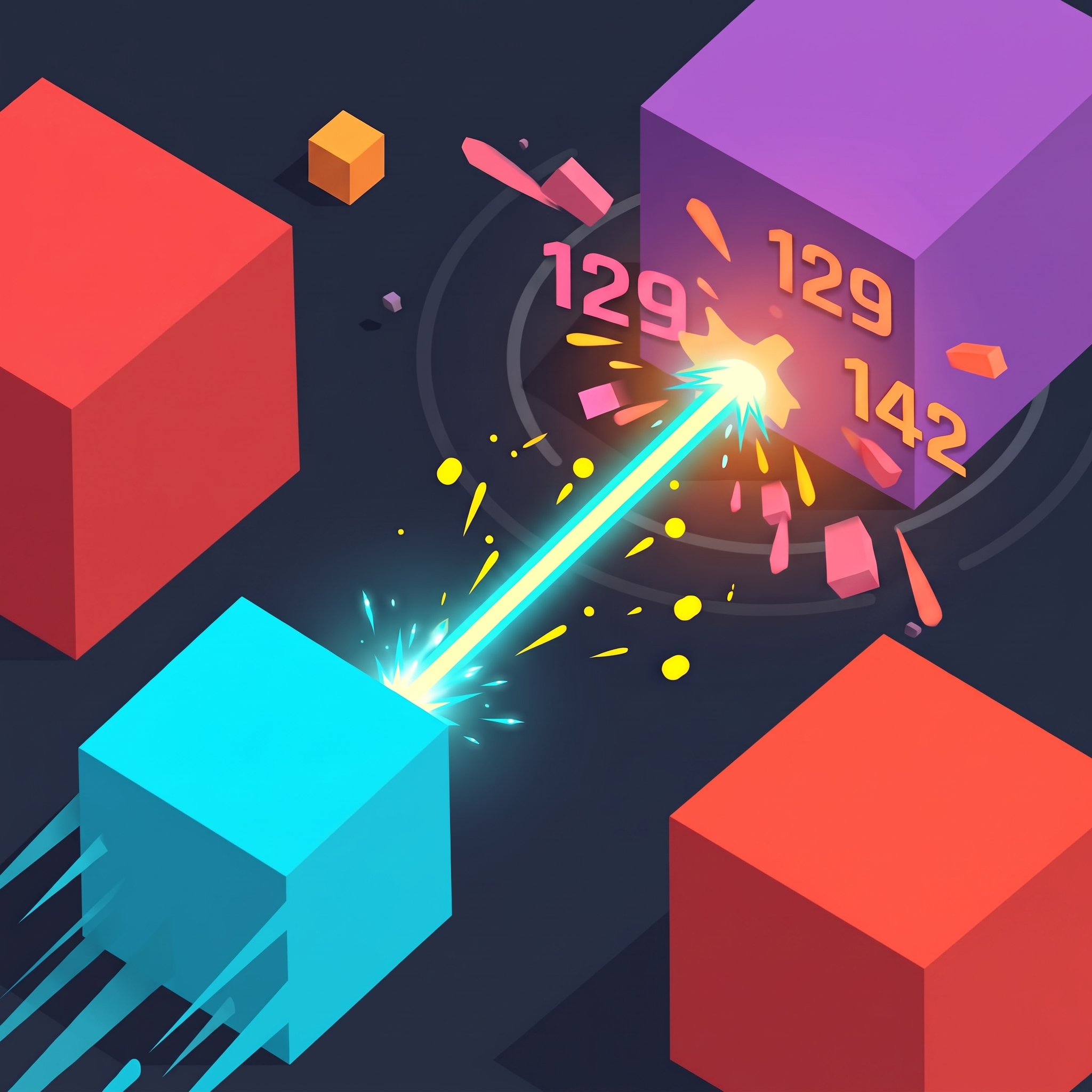
I designed and built Juice Box as a solo project using AI, with a deliberately simple combat game that makes the impact of game juice easy to see, hear and feel.
RoleGame Designer & Creator
StudioIndependent
Time on projectOctober 2026
TeamSolo project using AI
PlatformWeb browser
FocusGame feel, combat & balance
Game Overview
Game juice is what makes the core gameplay feel clear, responsive and satisfying. It comes from small layers of feedback such as animation, sound, recoil, particles, flashes and screen shake. Each effect adds clarity, weight or impact. Together, they can make even a simple action feel polished and rewarding.
Layer too many on, or tune them too aggressively, and they can create new problems. The game can become noisy, tiring, difficult to read and less accessible.
Why game juice matters
It confirms what happened and whether the player’s action worked.
It gives attacks, movement and interactions more weight.
It strengthens the personality of different weapons and abilities.
It makes simple mechanics feel more polished and rewarding.
What Juice Box demonstrates
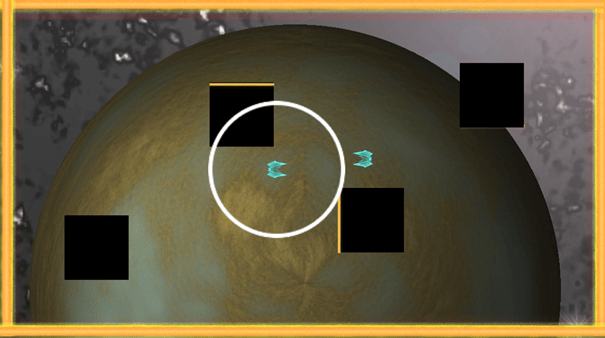
The game begins in RAW mode with the feedback removed.
More game feel is introduced as you progress.
Each weapon showcases a different combination of feedback and visual effects.
Simple enemies and rooms keep the mechanics, level design, balancing and progression easy to understand.
Some screen shake is intentionally pushed too far, showing when impact starts to become distraction.
Like The Game Industry Guide, Juice Box breaks a broad design principle into clear, practical pieces and lets you experience the lesson for yourself.
Feature Showcase
Player abilities
Dash: A quick burst of movement with a brief moment of invulnerability.
Ultimate: A targeted bomb that creates a powerful area attack at the cursor.
Upgrades: Damage, fire rate, piercing, extra projectiles, critical hits, health and loot range can all be improved.
Weapon system
Blaster: A fast and reliable baseline weapon.
Heavy Cannon: Slow, powerful shots with strong recoil, knockback and screen shake.
Scattergun: A wide spread with close range power, shell casings and a large muzzle flash.
Minigun: Builds from a slow spin into sustained fire, shell rain and continuous rumble.
Railgun: An instant piercing beam with a bright flash and lingering trail.
Rocket Pod: Accelerating rockets with smoke trails and area explosions.
The JUICE list
Readability: Hit flashes, health bars, damage trails and damage numbers.
Impact: Screen shake, knockback, recoil, camera kick and explosions.
Motion: Squash and stretch, particles, debris, muzzle flashes and tracers.
Anticipation: Attack telegraphs, pulsing warnings and wind up animations.
Reward: Loot bursts, magnetic collection, responsive interface animation and sound.
Boss battles and abilities
The Bruiser: A mini boss with telegraphed charges, heavy leaps, shockwaves and an enraged second phase.
The Monolith: A final boss with projectile spirals, expanding rings, targeted strikes, enemy summons and a faster second phase.
Clear warnings and readable phase changes keep the battles fair as the visual effects become more intense.
I helped shape the Heroes Meta update from concept to release, designed and reworked characters, and created Hero release events including the Sonic and Spike collaborations.
Designed the Heroes Meta update from concept to release, developing and iterating on pitch directions, meta systems, Quests, FTUE and balance, while collaborating closely with fellow designers to define and deliver the new Hero meta.
Helped design and release 5 Heroes and rework 30+ characters (Squaddies), creating and iterating on unique abilities, traits, and mechanics that aligned with the evolving game meta and contributed to a more dynamic and balanced gameplay experience.
Created and executed Hero release events, including the Sonic and Spike collaborations, designing event loops, progression systems, balance and rewards, while working with partners like SEGA to deliver high-quality, on-brand content.
Collaborated cross-functionally with UI/UX designers, producers, developers, and operations teams to ensure features and events were implemented cohesively and delivered to players at the highest quality.
Game Overview
Squad Busters is a fast-paced multiplayer mobile action game developed by Supercell, featuring iconic characters from the company’s popular franchises like Clash of Clans, Brawl Stars, Hay Day, Clash Royale, and Boom Beach. Players assemble squads of these characters to compete in dynamic 10-player matches, collecting gems and battling opponents across various game modes and maps.
Feature Showcase
Hero Meta
I designed the Heroes Meta update from concept to release, shaping a progression system that added meaningful long-term goals while maintaining accessibility and clarity. This involved developing and iterating on multiple pitch directions and meta structures that balanced depth with simplicity. The design focused on delivering a mix of exciting, high-value rewards (targeting $200 total per hero), consistent pacing without exponential progression curves, and reinforcing player agency by linking gameplay with Hero advancement. The system introduced strategic depth through layered progression paths, lightweight power scaling, and daily progress opportunities across multiple heroes—ensuring players always had something to work toward without feeling blocked. Throughout, I carefully managed system complexity, limiting new currencies and mechanics to keep the experience intuitive and engaging.
Examples of Meta Loops
While the Heroes Meta system succeeded in adding strategic depth and long-term progression, there were a couple of areas where improvements could enhance the player experience. First, the balance between stat upgrades and cosmetic rewards needed refinement. Players often felt forced to choose between underwhelming, lower-cost rewards and more meaningful but expensive stat progression, which led to upgrade fatigue. Introducing more frequent, smaller stat upgrade rewards would make progression feel consistently valuable across different player types and investment levels.
Second, the time required to fully upgrade a Hero was longer than ideal, creating a disincentive for players to experiment with or invest in additional Heroes. Once they committed to a favorite, the sunk cost often discouraged exploring the broader roster. A potential improvement would be to increase the availability of Hero Points (the upgrade currency) and implement ways for players to bring new Heroes up to a competitive level more quickly—ensuring greater flexibility and diversity in endgame play.
Quests
As part of the Heroes Meta update, I led a revamp of the Quests system to align with the new progression mechanics. Since quests became the primary source of Hero Points, I rebalanced the system by designing new quests focused on updated gameplay mechanics and hero interactions, while removing outdated versions. The goal was to encourage daily engagement by giving players a steady stream of currency they could use toward any hero—empowering them with more choice, flexibility, and a stronger sense of agency in how they progressed through the system.
Sonic Update
I led the design of a Hero release event in collaboration with SEGA and the Squad Busters team, focused on creating an engaging experience that would drive both retention and monetization. This involved aligning on creative direction, building a compelling event loop, and designing progression and reward structures that felt meaningful and exciting for players. Throughout development, I worked cross-functionally to ensure the event met both gameplay and business goals while staying true to the Sonic brand.
Unlock Sonic Event
Progress through a reward chain by collecting rings from battles to unlock Sonic, Sonic Hero Points and lots of additional rewards.
Upgrade Sonic
Use Sonic Hero Points to progress through 6 pages of content in Sonic’s personal Hero Journey!
Unlock Rewards
Unlock rewards within Sonic’s Hero Journey including Knuckles, Tails, Sonic gameplay abilities, cosmetics, chests and additional rewards.
Event Loop+ Wireframes
Event Release Video
Main Hero Event Screen
Hero Event Balanacing
For the Sonic Hero release event, I designed and balanced the player progression economy, ensuring a smooth and rewarding gameplay loop. I created and tuned the ring collection system—earned by busting monsters in the core—and mapped this to an event track with meaningful rewards. Through playtesting and iteration, I established the right pacing and numbers for progression, working closely with data analysts and live ops managers to launch a well-balanced, engaging event that delivered a great player experience.
I led the design of Chrome Valley Customs from early concept through global launch and live development, shaping its match-3 core, car-restoration fantasy, live operations and mini-games.
Led the design of Chrome Valley Customs, driving innovation from initial concept through to successful global release and beyond, delivering a desirable car restoration fantasy to a casual audience.
Collaborated and helped manage cross-functional teams through the entire game development lifecycle, from ideation to launch of numerous key features, resulting in a successful ‘puzzle and decorate’ car restoration core, performant car fantasy live ops and mini-games to increase regular customers.
Collaborated with leadership to develop the game’s strategic roadmap by gathering audience and team input, conducting research, and analysing player data for key decisions. Presented strategies to management for feedback, refinement and alignment.
Mentored and guided junior designers, fostering a collaborative environment that led to improved workflow and successful features delivered with improvement in KPIs.
Our Mission
Our mission is to marry a proven casual core to a broad, accessible theme and deliver a desirable player fantasy through an engaging meta that can be played for years. We aim to deliver on this mission by channelling the fantasy of car customisation and restoration into a game that pairs a rewarding Project Makeover-inspired meta with a supercharged match-3 switcher.
Game Overview
From sympathetic restorations to outrageous customisations, this game has it all.
Indulge in a huge variety of car restoration projects, make each project your own, and gain a real sense of satisfaction when your work is done. Meet your garage crew and get to know the ins and outs of the restoration business. Journey through different locations and garages, discovering the story behind every car and its owner.
Play through thousands of bold, responsive and delightful match-3 switcher levels, salvaging items and collecting money to faithfully restore cars to their former glory or make them bigger, bolder and better than ever.
The market opportunity for this game is created by our choice of theme. The top car themed games have driven 257 million downloads over the past 5 years in the US and Europe (for comparison, Home Renovation games generated around 270m downloads in the same period). However, the automobile theme is currently dominated by racing games. We therefore believe auto-restoration is a valuable and unexplored territory in which to position ourselves.
The auto restorer theme tested well in market research. We achieved 10% clickthrough (CTR), 1.4 times the CTR of our benchmark (Loved Up) in the same test. Conversion on a Storemaven app store reached 51%, also on a par with Loved Up.
As noted above, the auto-themed game market is dominated by racing games. We also wanted to check that respondents to a restoration themed ad wouldn’t still be expecting a racing game so we surveyed them. Overwhelmingly they preferred the restoration activity to racing.
Feature Development and Strategy Process
As part of the product leadership team to decide and agree on the next feature to tackle we formulated hypotheses we wish to test to to positively affect the overall performance of the game and target our winning aspiration for the company. This was achieved through vigorous discussions, research, collection and revision of data and performing a SWAG (Scientific Wild Ass Guess). We also required further research to make a decision so we performed a RICLE (Reach, Impact, Confidence, Longevity, Effort) analysis. After consensus and buy in we then moved into the feature development process.
The feature development process is built up of 3 main phases:
Design Phase
Prototype Phase
Production Phase
Design Phase
The design and product leadership team should try to reference where possible and use research to help inform our decisions as much as possible. Search for features and games outside the problem space or casual market. Identify or highlight some key games or features that could be cobbled together or help us start with a framework. Gain an understanding of what’s performing and what’s not.
Then we create design goals, player goals and product outcomes. This should speak to elements such as:
What hypotheses are we trying to test?
What are some of the design challenges we want to solve or address?
What behaviours and emotions do we want to elicit from our players?
What are the KPIs this feature will be targeting?
These goals can be created in parallel to market research so it can best inform the direction and space we want to move in. Or we might want to iterate on these goals after further research to best inform how we move forward.
Finally, we will open up a design inbox with the team, review and then create a spec and do several rounds of feedback until we are happy to kill or move on.
Prototype Phase
Create and iterate on Prototype/MVP, Test goals, Art exploration, UX MockUps and Plat test cloud. This should repeat until we find something we are happy with or kill.
Production Phase
Sprint Planning, feature production, reviews, polish, feature lock, bug fixing and release. Once we release we should review the performance and assess if we need a V2 of the feature.
Feature Showcase
Season Pass
A Season Pass is a limited-time event that rewards players as they progress through completing levels for exclusive rewards, such as in-game currency, power-ups and more. The season pass encourages consistent engagement, providing both free and premium tiers to appeal to all player types, and enhance the overall player experience with a sense of progression and achievement.
This was the first feature we developed post-global launch, designed to boost engagement and monetization in line with similar features used by our competitors. I led the design, creating the complete design document and user flows, and collaborated with the team to integrate it into the game. We discovered that the feature primarily drove monetization when focusing on rewards tied to Match-3 items and in-game currency. While it achieved significant monetization uplift, we concluded that customization items would be needed to further enhance player retention.
Crusher Carnage
Crusher carnage is a time-limited event where players must:
Beat levels to earn Crane Claws.
Use Crane Claws to uncover cars.
Find all the cars and progress through scrapyards to win all the rewards.
I led the design for Crusher Carnage and collaborated with a multidisciplinary team to bring the feature to life. I conducted market research, developed player flows, and worked closely with artists and UX designers to address key challenges, such as displaying target cars and optimizing the entire player journey. The feature was successfully released and drove a 9% increase in ARPU.
Twin Turbo
Twin Turbo is a permanent feature to boost monetisation
Win 10 levels to activate the Twin Turbo
Doubles the effect of Turbos!
The Twin Turbo will be active until you lose a level.
Twin Turbo was a feature aimed at boosting monetization throughout the entire M3 campaign. Due to shifting priorities, it moved in and out of the roadmap several times, changing hands among different designers. I initially created the design based on competitive analysis, and when the feature moved into development, a junior designer took the lead. I supported and guided design decisions during development, particularly with one of our main challenges: effectively representing player progression. Originally, we considered using a dial, but space constraints led us to use lights at the bottom to display multiple progression states. This required an abstract animation to indicate active and inactive states consistently. This also meant we could easily show the different states across the different screens in the game.
Gaskets Gridlock
Gasket Gridlock is a mini-game whereby players must:
Win M3 levels to gain energy
Use energy to remove cars that are blocking the roads
Progress through all the levels to win prizes!
Gasket’s Gridlock was designed as a mini-game within CVC to engage and monetize our regular players. I supported a junior designer who led this feature, providing feedback and guidance throughout development. Additionally, I contributed to the creation of content for the many levels within the mini-game
Drag Race
Race with your own restored cars
Beat levels to collect tokens and upgrade the cars performance
Win races to earn amazing prizes
Compete in multiple cups to earn even better prizes.
Drag Race was primarily developed in collaboration with Creative Mobile, a company with extensive experience in racing games, making them an ideal partner for bringing this feature to life. Our team handled the final stage of development, adding new features, balancing gameplay, and polishing the overall experience. I contributed by creating a design brief, refining the initial concept, and providing feedback throughout the process, especially during the final development phase to ensure quality and alignment with our vision.
The Business – Deep dive
Our mission is to add a compelling feature that fulfils the tycoon promise of Chrome Valley Customs and engage and monetise a broader audience of regular players.
We aim to do this by adding resource management and idle mechanics to a canvas that the player can build and customise over many years of play. The core experience should stand alone from the puzzle and decorate loop but also encourage regular engagement with match 3 to maintain our primary monetisation vector.
Feature Overview
The canvas map feature will provide the fantasy of building, running and upgrading a car business through the use of:
A canvas map where players can build, upgrade and interact with buildings and car customers
Manage resources from scrap, wheels, paint, engines and body parts, to fix, restore and build cars
Earn cash and build a profit through fulfilling orders
Expand, decorate and grow your car business
It will be a permanent feature accessed via a button on the garage home screen. The core loop of the feature will include:
Salvage Scrap
Produce Goods
Fulfil Orders
Collect Cash and Build
The canvas feature will be fueled from playing match 3 levels for chests that players use to collect items to help with their production chains.
Play Match 3 and gain chests
Use goods to help with their production chains
Earn Cash and XP from fulfilling orders
I was tasked with creating a business feature using the reference of Township. I had to create and design:
An entire car fantasy economy with hundreds of items, production chains and buildings.
A new innovative way to represent the car fantasy of buying and selling cars in the “Car Lot” and the collection of scrap in the scrapyard.
The FTUE, task system, train station, M3 chest system, shop, customer/reputation system, map layout and numerous small features required to integrate this meta feature with the core.
Above you can see the many items being grouped and designed for the economy and below the art for them all.
Furthermore, the entire economy had to be set up and maintained in Excel where we tracked everything and integrated it into Unity.
Ultimately we ended up killing this massive feature as it didn’t perform. The goal was to increase regular customers and we saw little impact. I think my biggest learnings were:
We qualified our decisions with a lot of research and questionnaires but in the end it wasn’t for everyone. I would be more cautious of survey results and small PTCs as they can give you false negatives.
We saw success in Township applying a causal game mode (M3) to a more hardcore genre resource management. Looking back now it makes sense that our player would find it hard moving to a more core feature. Even after they stated they wanted more tycoon, business simulation. We just didn’t make the right feature for our audience.
Taking on a big feature like this we need to be able to test earlier and gain validation on the feature with the real audience at scale.
I would get more people involved earlier to help with validating the direction. A few people weren’t 100% with the direction. I should of worked harder to fix those concerns before we released.
I led Farm Heroes Saga’s four-person level design team, creating and improving content, features and live operations for one of King’s long-running mobile games.
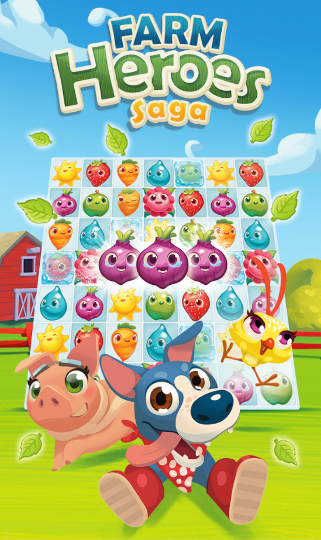
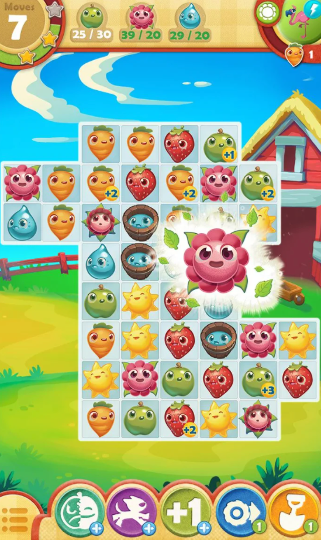
Farm Heroes Saga is a mobile match-3 puzzle game from King. Players match Cropsies to complete level objectives, while new mechanics, events and regularly released content support long-term play.
Responsibilities
Lead Level Designer on Farm Heroes Saga, leading a team of four level designers and creating and maintaining game content to attract, engage and retain 7 million daily active players.
Content production, balancing, optimisation, live operations, MLOs, A/B tests and QA testing.
Owned switcher mechanics and improvements, working with a multidisciplinary team to ensure the best game content and features were created within the required scope and timeframe.
Worked with the leadership group to plan roadmaps, prioritise features on the backlog and represent the level design craft to gain buy-in for the work.
Created and planned live experiences, including Halloween and Christmas events.
In-game content
Portfolio collaboration
Impact across the King portfolio.
As part of King’s Lead Level Design group, I collaborated with teams across the wider portfolio—including Candy Crush Saga, Candy Crush Soda Saga, Candy Crush Jelly Saga, Candy Crush Friends Saga, Bubble Witch 3 Saga and Pet Rescue Saga.
We shared learnings across retention, monetisation, level design and core gameplay systems; reviewed work, challenged assumptions and helped teams apply successful ideas across titles. This extended my impact beyond Farm Heroes Saga, strengthening design decisions, developing the craft together and supporting better KPIs and performance across the portfolio.
Candy Crush Saga
Candy Crush Soda Saga
Candy Crush Jelly Saga
Candy Crush Friends Saga
Bubble Witch 3 Saga
Pet Rescue Saga
One example from the portfolio
Candy Crush Friends Saga
This official trailer gives a glimpse of another King title supported by the wider craft group.
Currently Lead Level Designer on Farm Heroes Saga leading a team of 4 level designers, creating and maintaining game content: to attract, engage and retain 7 million DAU.
Content production, balancing, Live Ops, MLO’s, AB tests and QA testing.
Ownership of switcher mechanics and improvements, working with a multi-disciplinary team to ensure the best game content and features are created in the scope and time required.
Game Design responsibilities owning features from conception creating design specs and working with the team to release. For example Farms Season pass and Teams feature.
Working with other leads to plan and create the roadmap, prioritising features on the backlog, representing the level design craft to gain buy in for work.
Live op team – creating and planning experiences for example, Halloween and Christmas etc.
Setting up and creating team processes, ways of working within the level design team and the greater game team. For example: EOC Optimisation, pre-releases 4% / Double cadence 3.4% uplift.
Working and communicating with several different departments including – CRM, BPU, Data
Scientists, Branding, Advertising, Community Managers to create the best game experiences and performances possible.
Mentoring and coaching designers, supporting level design to help create a culture of continual learning and sharing across multiple teams.
Interviewing and responsible for staffing across multiple teams.
Built from the first level to a complete social match 3 game.
I led the content pod, created the full difficulty curve and helped shape the core gameplay, blockers, boosters and social systems behind Farm Heroes Champions.
RoleLead Level Designer
StudioKing
Time on projectMay 2017 – Jan 2021
PlatformiOS & Android
FocusCore, content & social
Content1,000+ levels
Game overview
Farm Heroes Champions was a new social match 3 game in the Farm Heroes universe. Players completed levels, collected rewards and worked with a team through shared progression, Team Chests, contests and leaderboards.
Responsibilities
Led the content pod and coordinated weekly delivery across levels, chapter art, blockers and live content.
Created the difficulty curve from the beginning, built the first 300 levels and helped the team grow the game beyond 1,000 levels.
Designed onboarding, tutorials and level design processes for balancing, feedback and content delivery.
Worked with data science and business performance teams to analyse playtests, churn and difficulty.
Oversaw the design, art and development of 20 blockers, three pregame boosters and four in level boosters.
Design pillars
Community
Players should feel that they belong to a team, contribute to shared goals and benefit from helping one another.
Flow
The switcher should be easy to understand, satisfying to play and supported by progression that keeps players moving forward.
Reward
Levels, team activity and progression should create generous rewards with clear feedback, quick cascades and a strong sense of achievement.
Level design system
I built a repeatable process around board shape, blocker synergy, colour count, objectives, progression, clarity and difficulty. Each level was playtested and tuned through moves, goals, spawn rates and blocker values until the intended player journey felt clear and rewarding.
Core gameplay showcase
Blockers
Blockers were designed to scale across many levels, combine cleanly with other mechanics and create satisfying moments. Dandelions reduced together over several matches, while Wheat encouraged players to clear a complete patch before it regrew.
Pregame boosters
Cropsie Blast, Cropsie Bomb and Rainbow Cropsie were designed to be simple, powerful and compatible with the match 3 core. Blast and Bomb could trigger one another, creating readable chain reactions and strong moments of payoff.
In level boosters
The Watering Can created impact by multiplying a chosen Cropsie and generating cascades. The Glove gave players more agency by letting them swap any two Cropsies and set up a deliberate match.
I created episodes, balanced the difficulty curve and worked with a three person level design team to deliver clear, varied and rewarding content.
RoleLevel Designer
StudioKing
Time on projectMay 2017 – Jan 2021
PlatformiOS & Android
Team3 level designers
FocusLevels, balance & live content
Game overview
Farm Heroes Super Saga expands the Farm Heroes formula with new Cropsies, blockers and level goals. My work focused on producing and balancing a dependable stream of levels for a live audience.
Responsibilities
Created levels and complete episodes using a broad mix of mechanics and blockers.
Worked within a three person level design team to deliver new content every week.
Reviewed and optimised levels, giving clear feedback to other designers.
Analysed churn and difficult levels to improve the overall difficulty curve and player experience.
Feature showcase
Episode design
Each episode needed a clear rhythm of challenge, variety and recovery. I combined mechanics and blockers carefully so new ideas were introduced cleanly and then developed across the episode.
Difficulty balancing
I reviewed level performance, churn and failure points to identify sharp spikes. Levels were iterated through layout, moves, goals and blocker values until the curve felt demanding but fair.
Team feedback
Regular reviews helped us improve individual levels while keeping the full release consistent. Feedback focused on clarity, pacing, mechanic synergy and the intended player journey.
I designed large-scale licensed worlds, competitive Battle maps and Glide racing courses for Minecraft: Console Edition, translating recognisable IP into detailed, readable and rewarding spaces.
RoleLevel Builder & Designer
Studio4J Studios
Time on projectAug 2016 – May 2017
PlatformsXbox, PlayStation & Wii U
TeamApprox. 20-person team
FocusWorlds, Battle & Glide
Game overview
Minecraft: Console Edition brought Minecraft’s open-ended building and survival experience to console audiences. At 4J Studios, I worked as part of an approximately 20-person team across licensed mash-up packs, tutorial-world content and competitive mini-games, turning established IP and ambitious creative briefs into polished Minecraft spaces.
Responsibilities
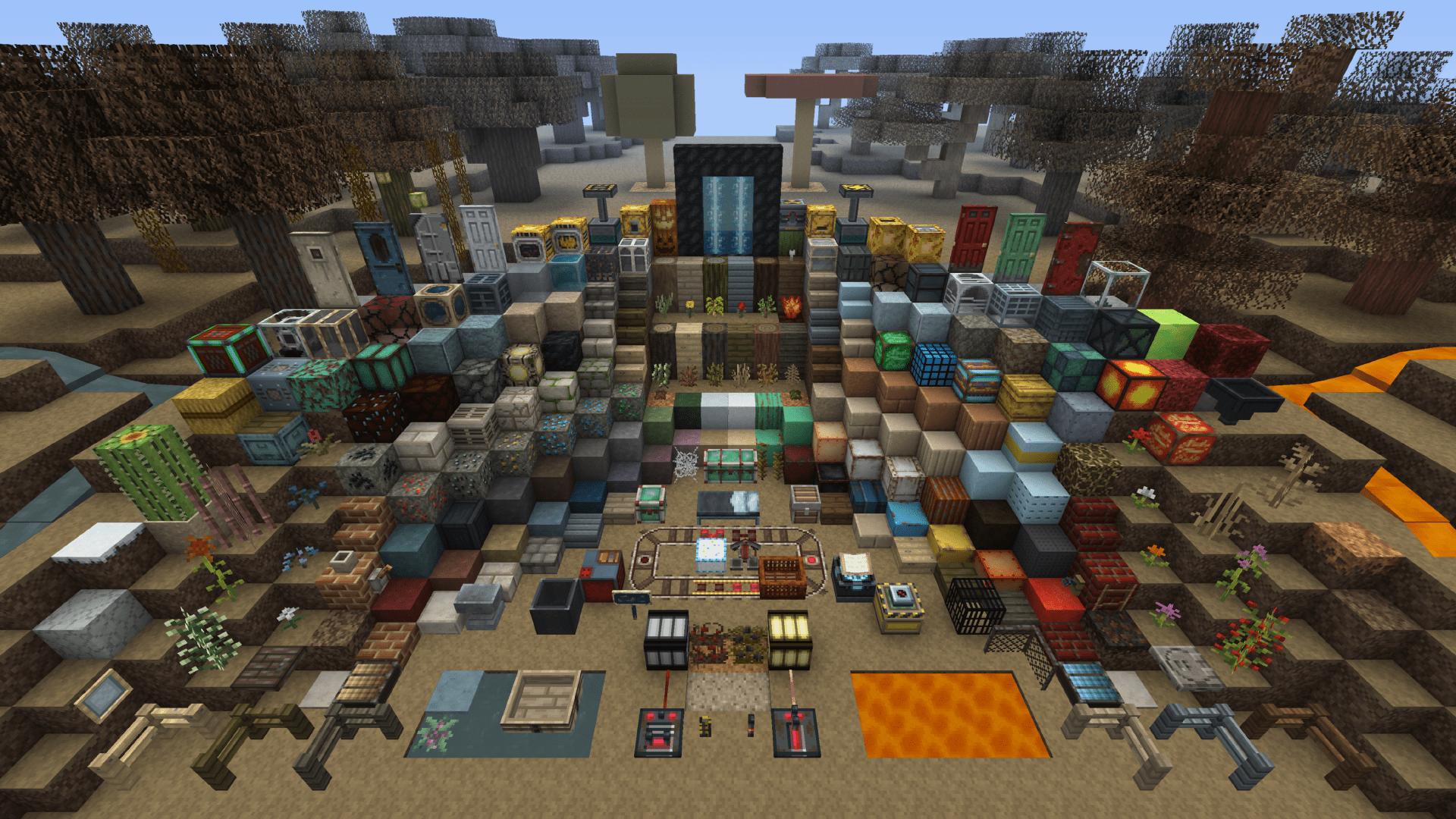
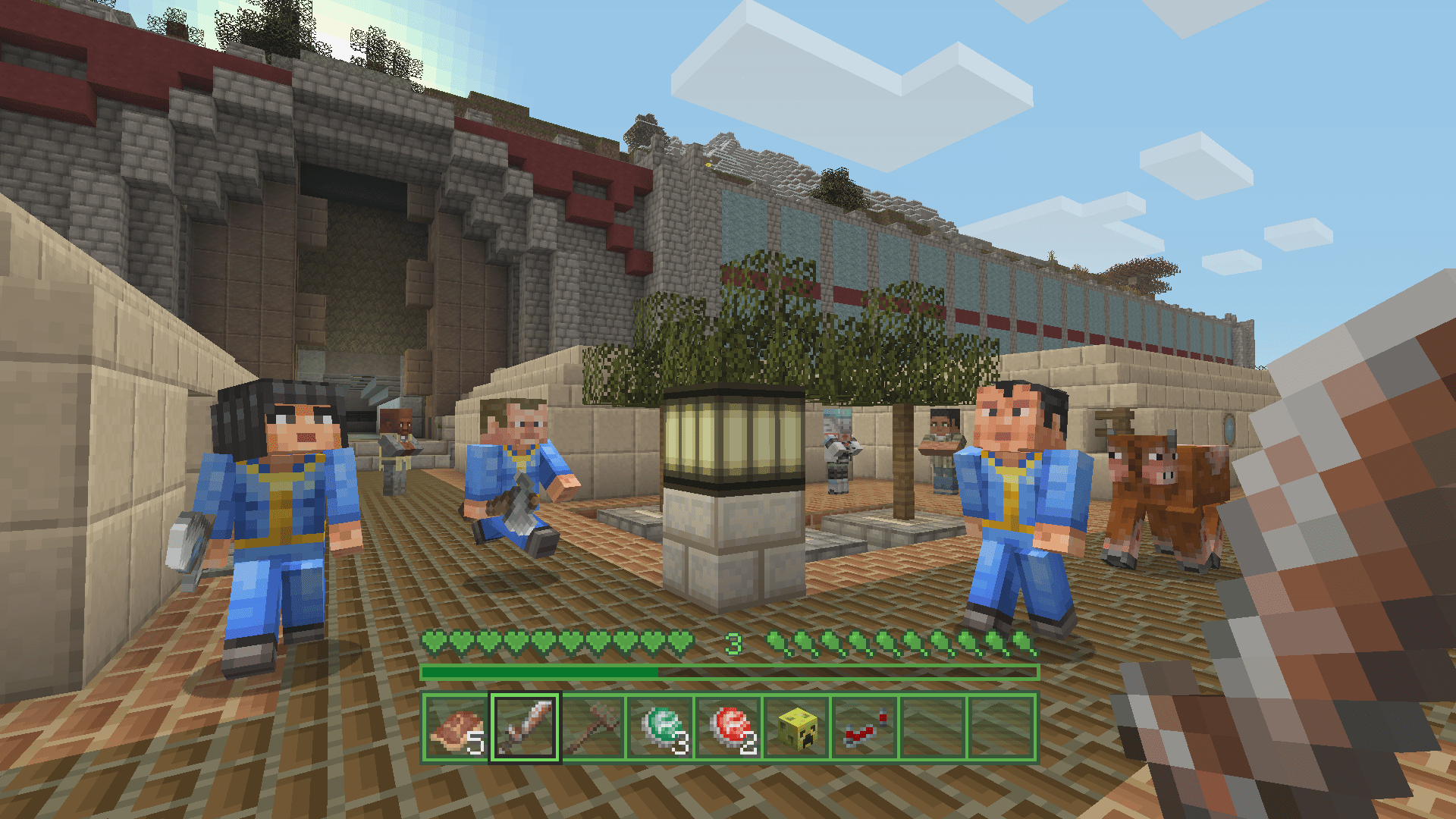
Designed and built large-scale licensed mash-up worlds for IP including Fallout and Adventure Time, translating recognisable locations, landmarks and atmosphere into Minecraft’s block-based visual language.
Worked closely with designers, artists and production while meeting licensor requirements, reviewing source material and iterating so each world felt authentic within platform, schedule and quality constraints.
Constructed enormous, highly detailed environments from the ground up, using proportion, silhouette, texture, colour and landmark placement to mirror the original games while remaining clear and rewarding to explore.
Owned key areas including Fallout’s Institute and Adventure Time’s Candy Kingdom, solving level-design problems and carrying spaces from early blockout through polish and QA.
Designed competitive Battle maps and Glide racing courses, balancing routes, spawn points, shortcuts, interactive elements and difficulty for different player counts and skill levels.
Playtested and completed QA across content, identifying escape routes, stuck points and bugs before iterating with the wider team to deliver polished releases.
Fallout Mash-Up Pack
Working with the team, I recreated recognisable Fallout spaces within Minecraft’s constraints. I took ownership of specific areas and used complementary textures, colour, landmarks and route structure to retain the source fantasy while supporting clear navigation.
Built Fallout-themed adventure areas and features from the ground up.
Worked from reference material to translate the world into Minecraft’s block-based visual language.
Iterated with designers, artists and QA to deliver polished spaces to schedule.
Holiday Update tutorial world
I created large areas and features for the Holiday Update’s tutorial world, balancing visual spectacle with a clear onboarding and exploration journey.
Designed and built areas with the wider design and art team toward a shared deadline.
Used landmarks, layout and player flow to support teaching and discovery.
Playtested and resolved bugs, stuck points and unintended escape routes.
Battle mini-game
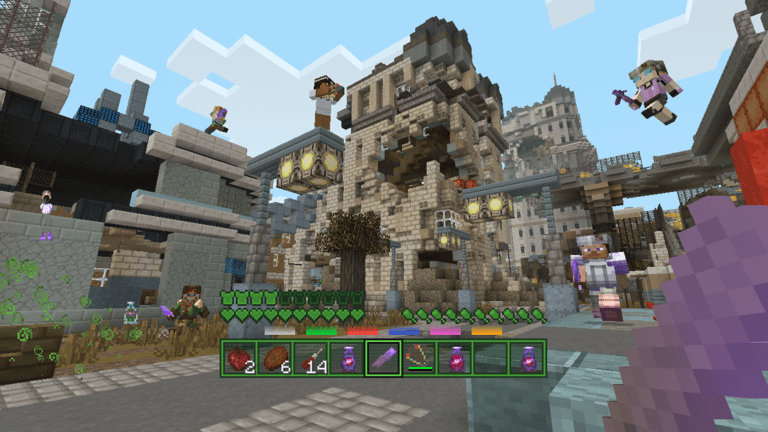
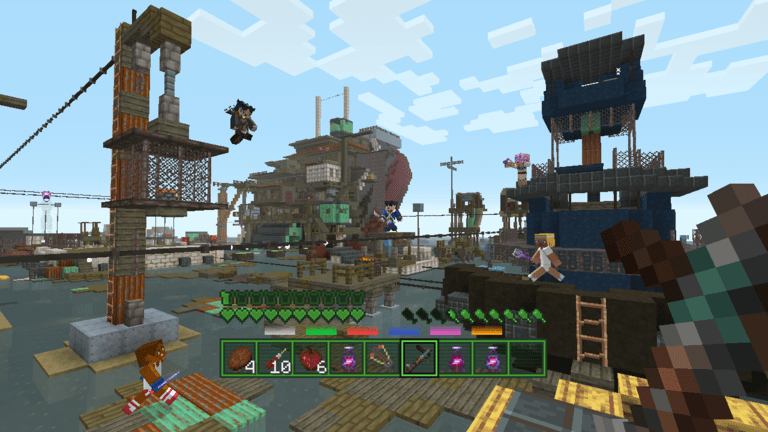
I helped create three Fallout-themed Battle maps—Capitol, Libertalia and Atomics Galleria—with the greatest ownership over Atomics Galleria.
Adapted recognisable Fallout spaces for competitive multiplayer balance.
Created map versions for smaller and larger groups, refining spawn points and routes.
Placed chests, traps and interactable elements including buttons, bombs, lights, trip wires and archer towers.
Playtested and completed QA to improve clarity, fairness and replayability.
Glide mini-game
I helped design four Glide courses—Cavern, Dragon, Kraken and Yeti—with the greatest ownership over Yeti.
Planned routes on paper before building and iterating them in-game.
Created easy, medium and hard routes with shortcuts and risk-reward choices.
Placed rings, thermals and speed boosts to shape flow, pacing and mastery.
Playtested and completed QA across courses to support fair competition.
Adventure Time Mash-Up Pack
I designed and built areas inspired by the Adventure Time IP, with the Candy Kingdom as my main focus. I used spatial composition and texture choices to make recognisable locations work as explorable Minecraft spaces.
Translated established locations into a coherent block-built world.
Balanced visual accuracy with navigation, discovery and playability.
Playtested and completed QA to ensure the areas were stable and polished.
A four player infection game built around changing teams.
I designed the scoring, abilities and multiplayer arena for a fast local game where every player gets a turn as the hunter.
RoleGame & Level Designer
ContextStudent project
Time2015 – 2016
PlatformPC
Players4 local
FocusSystems, abilities & level flow
Game overview
R.A.W.R is a four player battle arena game set in London. One player controls Big Zilla while the others play as Wee Zillas, earning points over time and using routes and abilities to avoid infection.
Responsibilities
Designed the asymmetric infection loop and the changing team structure.
Created the scoring system and abilities to keep every player invested in the result.
Designed and iterated the arena around shortcuts, conflict points and player flow.
Playtested the game to improve tempo, readability and competitive balance.
Feature showcase
Investment
The scoring system keeps players interested in every role. Wee Zillas build points while Big Zilla creates immediate pressure, so the outcome can change throughout the match.
High tempo
The arena and abilities were designed to create frequent contact, quick decisions and constant movement rather than long periods of avoidance.
Dynamic teams
Infection changes each player’s goal during the match. This produces temporary alliances, rivalry and a strong sense that every action affects the wider game.
Level flow
Small routes give Wee Zillas escape options that Big Zilla cannot use. Main paths, shortcuts and resource placement pull players back toward shared conflict points.
I helped design a side scrolling puzzle platformer where changing character perspective transforms the environment and opens new solutions.
RoleGame & Level Designer
ContextStudent project
Time2015 – 2016
PlatformPC
GenrePuzzle platformer
FocusCharacters, puzzles & levels
Game overview
Frozen with Fear follows four characters who perceive the same room in different ways. Selecting a character transforms elements linked to their phobia, allowing the group to work together and reach the end of each level.
Responsibilities
Defined design goals around empowerment, interactivity and approachable puzzle logic.
Designed character abilities that turned each phobia into a useful environmental tool.
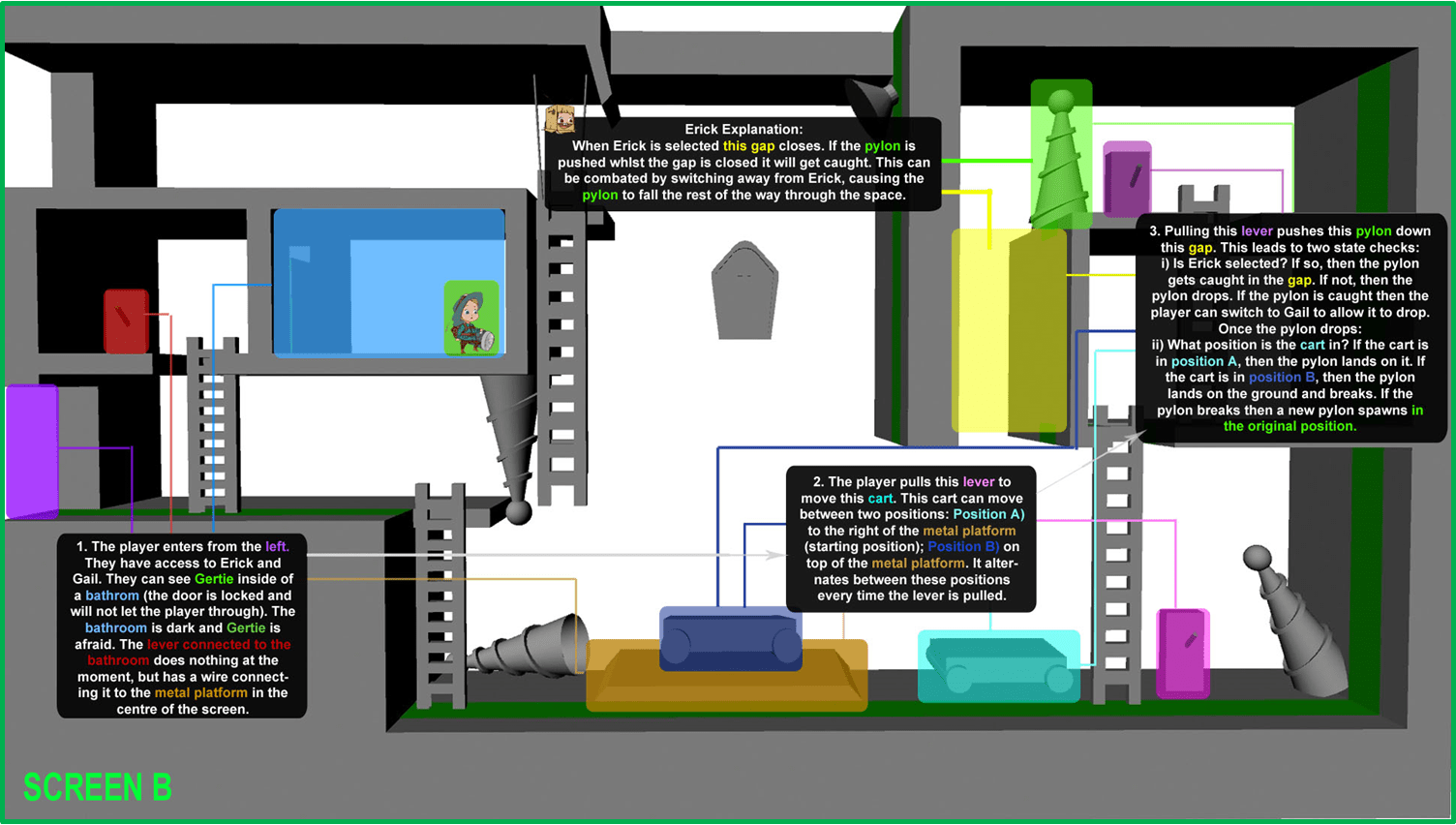
Created layered puzzles requiring players to combine perspectives across the level.
Iterated layouts and puzzle sequences to improve clarity, visual impact and mechanical challenge.
Feature showcase
Empowerment
Phobias are tools rather than restrictions. The design gives players a positive reason to switch perspective and makes every character essential to progress.
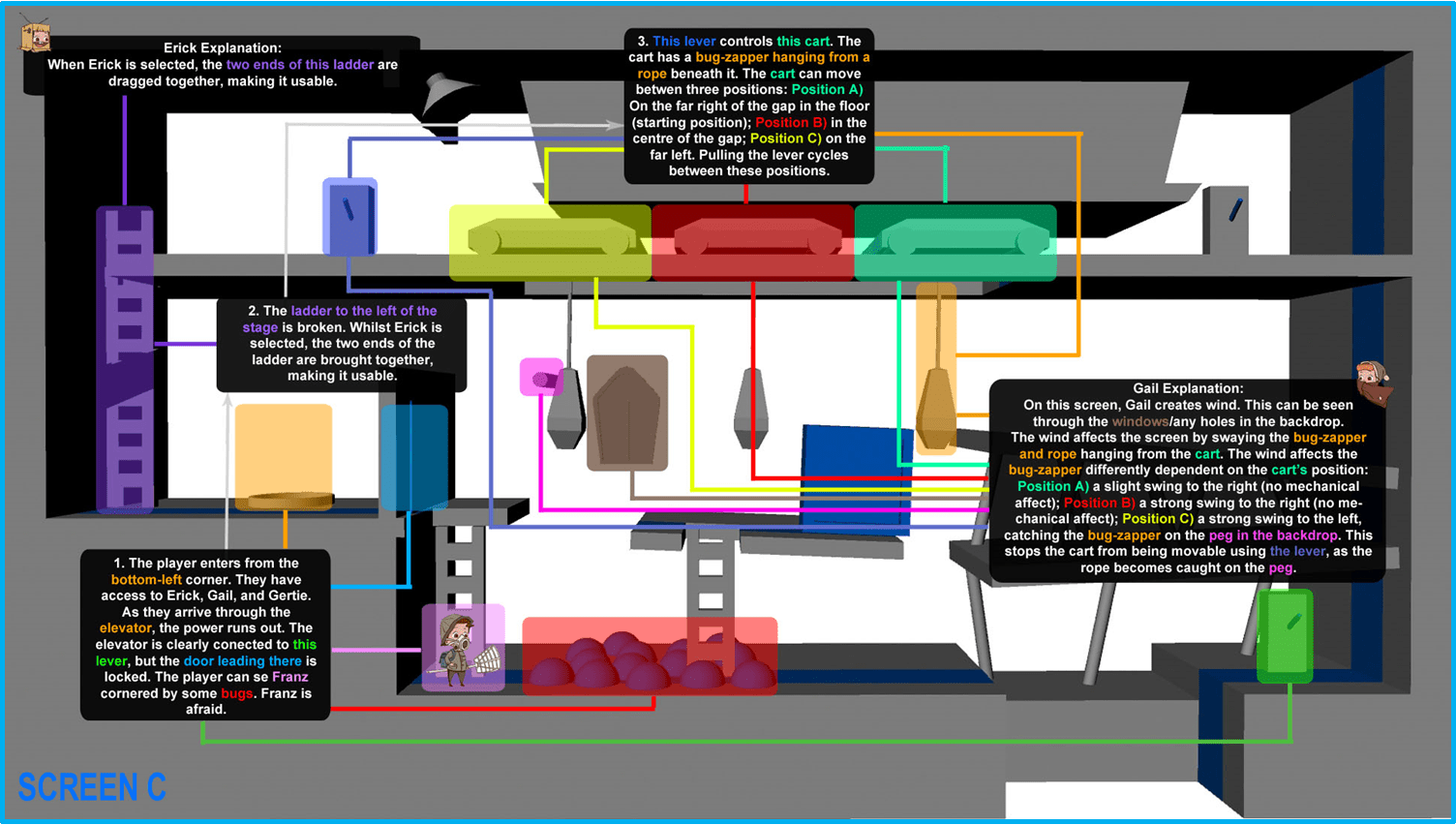
Franz and insects
Insects grow into useful objects. Beetles can transport items while fireflies illuminate large parts of the environment.
Gertie and darkness
Darkness becomes sharp and physical, cutting ropes and removing creatures that block the route.
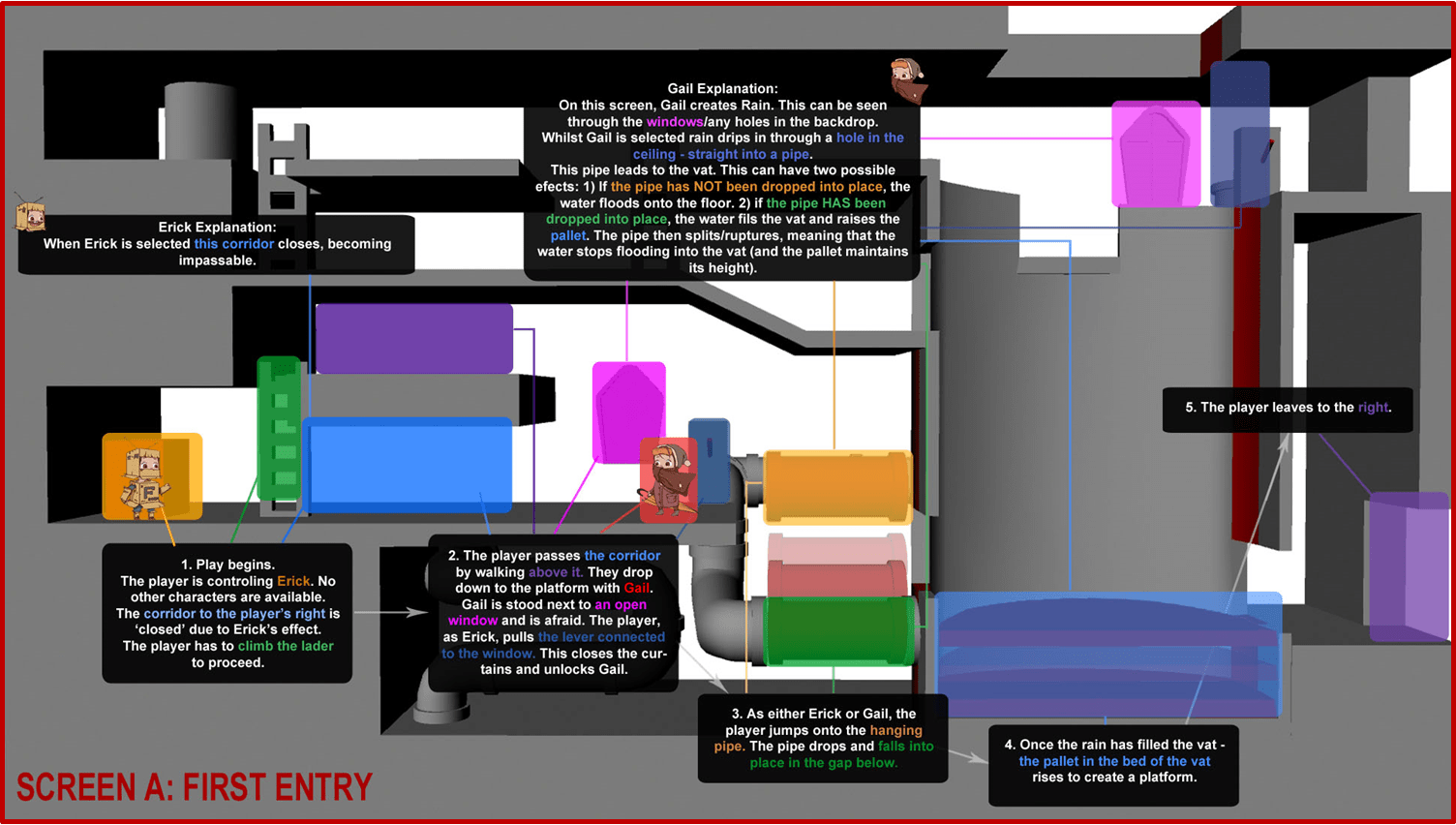
Erick and enclosed spaces
Claustrophobic spaces transform into structures that bridge gaps or trap objects inside narrow passages.
Gail and weather
Lightning powers generators, rain fills pipes and wind moves objects such as curtains and bug zappers.
A competitive climbing game where every object can be weaponised.
I designed the modular levels, interactive obstacles, abilities and interface for a fast local multiplayer game built around movement and disruption.
RoleGame & Level Designer
ContextStudent project
Time2015 – 2016
PlatformPC
PlayersLocal multiplayer
FocusLevels, abilities & UI
Game overview
The Fall is a fast 2.5D local multiplayer game where players climb through a moving level and compete to hold the lead for 30 seconds. Shots rotate objects, trigger hazards and create opportunities to disrupt other players.
Responsibilities
Designed a pregame lobby that doubled as a safe tutorial for movement, shooting, hazards and readiness.
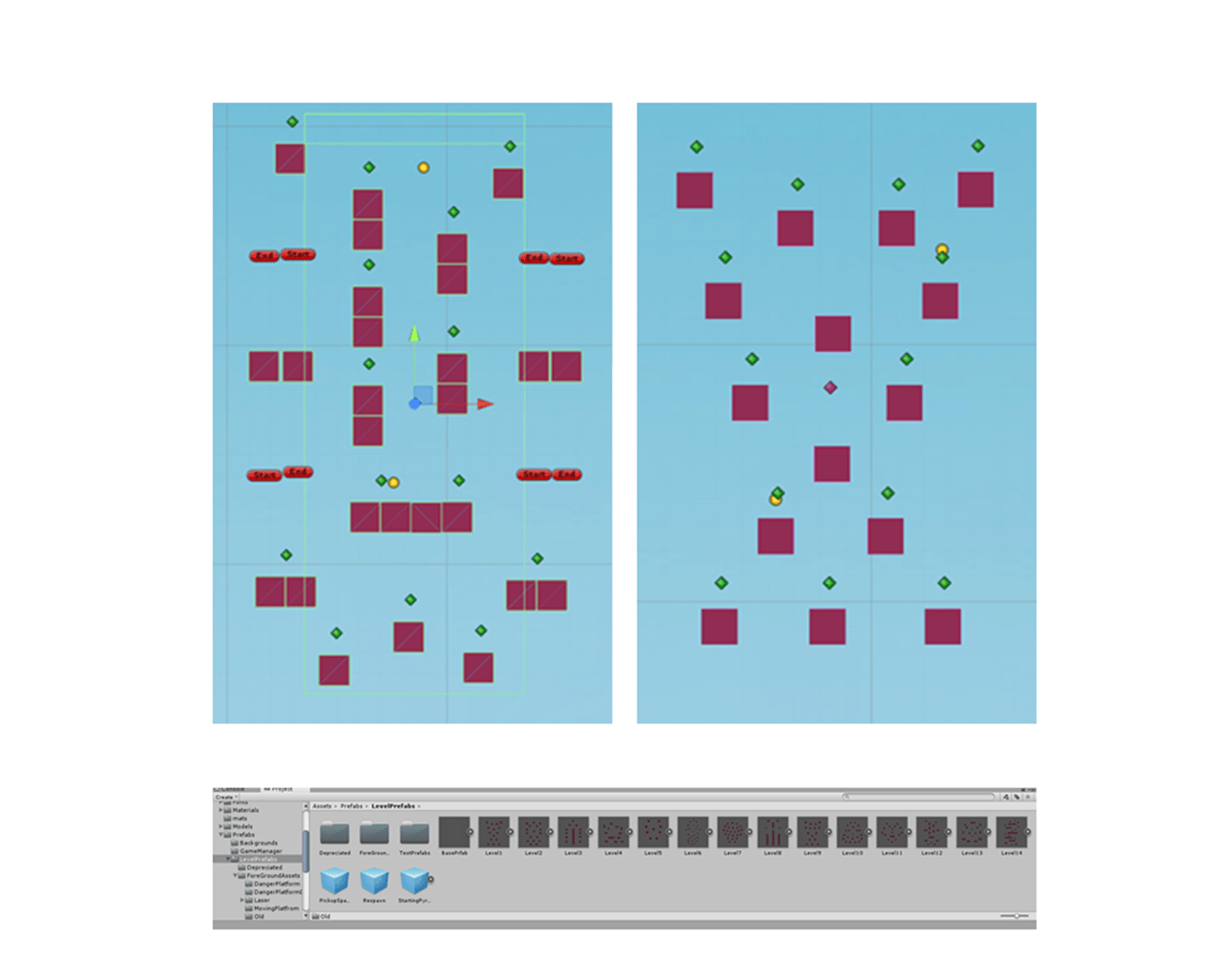
Built 14 modular level sections that could be combined in a different order each match.
Designed interactive obstacles, spawn points and power up placement around flow and competitive counterplay.
Created and balanced abilities including Destructo Shot, position swap, Rotate All and Slow Time.
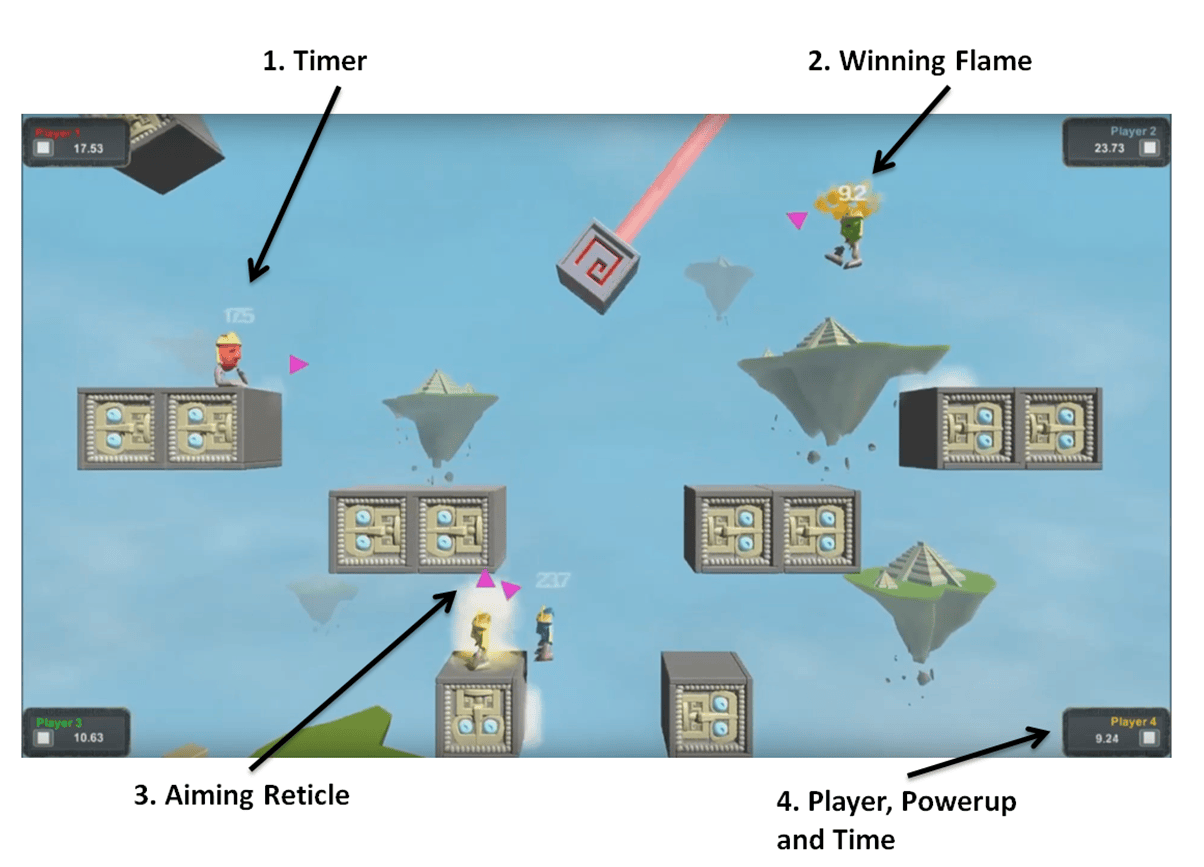
Designed clear player timers and aiming feedback, and created player animations to support the small art team.
Feature showcase
Fast pace
Constant upward movement creates urgency. Level sections, hazards and abilities were built to keep players making quick decisions while preserving readable routes.
Competitive interaction
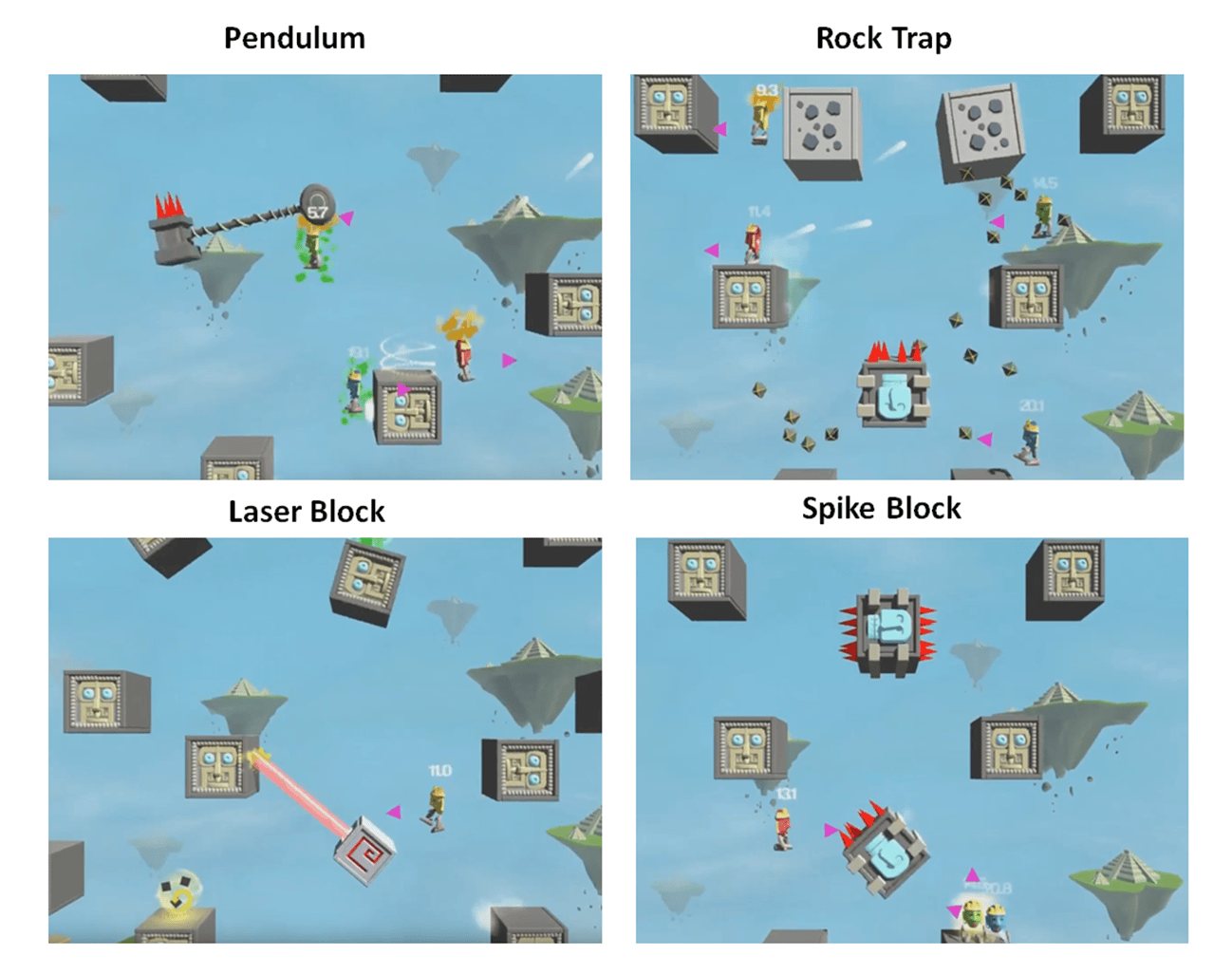
Players can manipulate blocks, lasers, pendulums and traps. The same object can help the leader or create a catch up opportunity depending on timing and position.
Modular level system
Fourteen prefabricated sections were assembled in a random order. Careful boundaries, connections and spawn placement ensured every combination remained traversable and fair.
Ability showcase
Destructo Shot temporarily disables a platform so opponents fall through it.
Position Swap exchanges the user with the current leader and creates a strong catch up moment.
Rotate All changes every interactive object at once, producing dramatic map wide disruption.
Slow Time gives one player space to assess hazards, catch up or extend a lead.
UI and feedback
Timers sit above each character so everyone can read the state of the match. A flame marks a player close to victory, while a simple aiming indicator keeps interaction clear during fast movement.
A one versus one arena about capturing shrines and completing a ritual.
I designed the arena, objective placement and skill based abilities for a competitive local prototype made during Global Game Jam 2016.
RoleGame & Level Designer
EventGlobal Game Jam 2016
Time48 hour prototype
PlatformPC
Players2 local
FocusArena, abilities & balance
Game overview
Spirit Rush is a local battle arena created around the theme of ritual. Players capture their assigned shrines, use abilities to interrupt one another and race to open the final portal.
Responsibilities
Developed the game concept from the jam theme as the team’s only designer.
Designed the multiplayer arena and objective placement around player interaction.
Created Spirit Dash, Spirit Bomb, Freeze and Block abilities.
Playtested cooldowns, ranges, damage and routes to improve balance and competitive clarity.
Feature showcase
Arena flow
The first layout allowed players to focus on objectives without meeting. I lengthened the map, created a central bottleneck and placed mandatory objectives across that shared space to produce meaningful combat.
Spawn and movement balance
Additional spawn points reduced downtime and placed players closer to the action. Central blockers prevented Spirit Dash from bypassing the main conflict space.
Ability redesign
Early abilities required too little skill. Turning them into aimed skill shots created more readable counterplay, greater mastery and a more competitive experience.
A 24 hour party game built around push and counterpush.
I helped create a four player arena where pulse waves, bombs and chain reactions turn simple movement into fast competitive chaos.
RoleGame & Level Designer
Context24 hour game jam
PlatformPC
Players4 local
GenreParty arena
FocusMechanics, balance & sound
Game overview
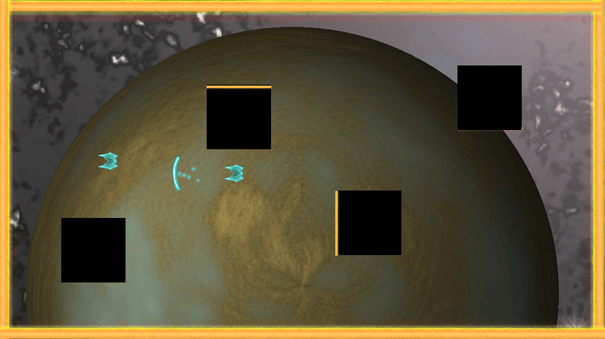
Impulse is a top down four player couch game made in 24 hours. Players dash through a compact arena, pushing opponents toward lasers with pulse waves and large pulse bombs.
Responsibilities
Designed the arena around cover, symmetry and lasers that push action toward the centre.
Created the pulse wave, pulse bomb and interactive collision bomb mechanics.
Playtested and tuned movement, force, timing and arena readability.
Contributed to the sound design and the overall feel of the prototype.
Feature showcase
Pulse wave
A direct push tool that lets players control space, protect themselves and knock opponents into the surrounding lasers.
Pulse bomb
A larger area effect creates immediate pressure and interacts with other pulses, players and the arena.
Collision bomb
When two pulse bombs meet they create a new expanding hazard. Other players can push it around the map, turning a simple collision into a shared tactical problem.
Arena readability
Four players created a busy screen, so colour and a symmetrical layout made each character and threat easier to track. Lasers facing inward kept the centre dangerous and prevented passive play.
A BAFTA Young Game Designers idea built into a playable world in four weeks.
I designed the levels, magic abilities, enemies and environmental interactions for a 17 person multidisciplinary student production.
RoleLevel Designer
PartnerBAFTA YGD
Production4 weeks
Team17 people
PlatformPC
FocusLevels, abilities & enemies
Game overview
Dreams began as a winning BAFTA Young Game Designers concept. Our Abertay University team transformed the young designer’s ideas into a playable vertical slice, which was later showcased during a visit by the Duke and Duchess of Cambridge.
Responsibilities
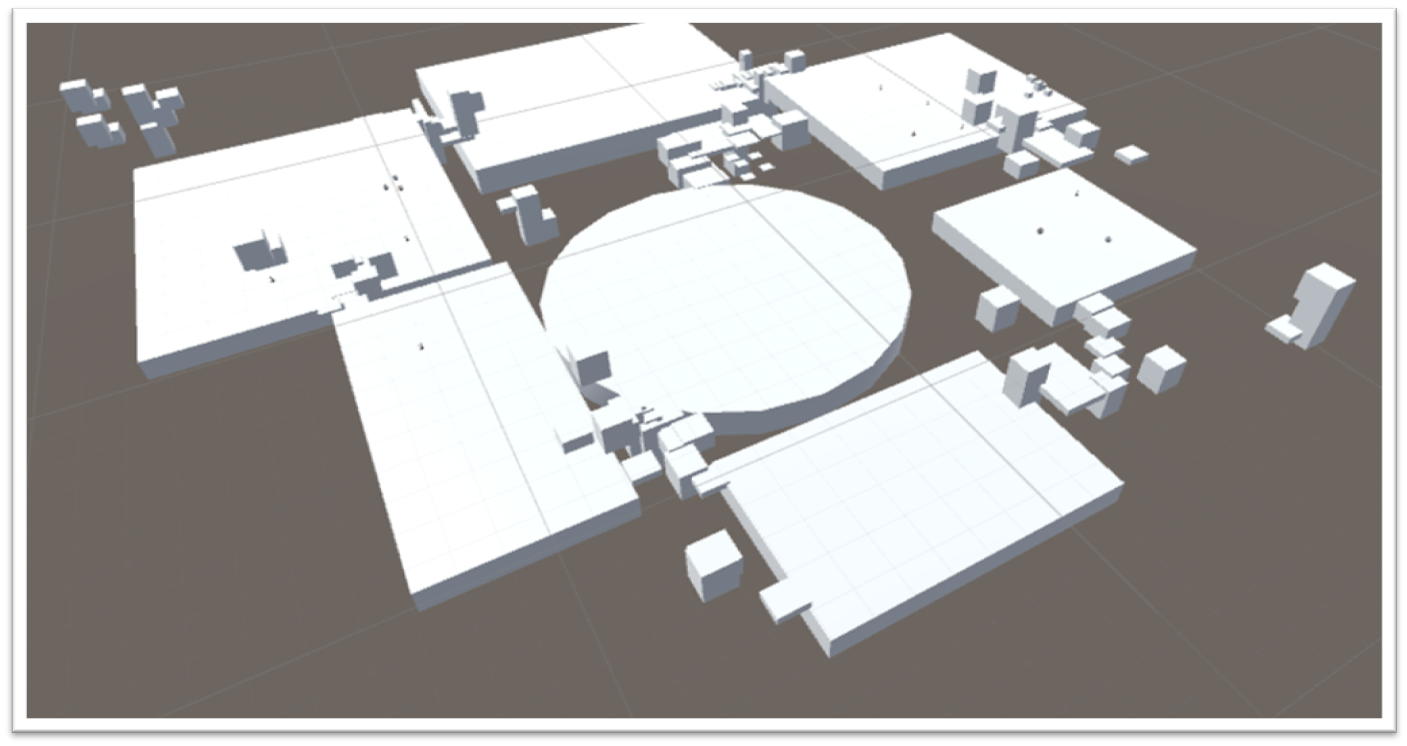
Designed and iterated the level layout, encounter flow and key story moments.
Defined three types of magic, including their enemy interactions, damage and resource costs.
Designed enemies that split when damaged and grant a temporary melee benefit when defeated.
Created environmental shields that required specific abilities to destroy.
Contributed to audio design and recording across the game.
Feature showcase
Designing from a young creator’s vision
The source material was deliberately open, so the challenge was to expand the idea while protecting its identity. Moving platforms, enemy waves and magical obstacles gave the dream world a clear gameplay structure.
Magic and interaction
Three magic types needed distinct roles, readable costs and useful environmental interactions. Their differences supported both combat decisions and puzzle progression.
Scoping the vertical slice
My first prototype was too large for the four week production. I reduced the space and concentrated every important mechanic into a short experience that could be tested, understood and polished.
A rhythm platformer created from a young designer’s prototype.
I helped translate a BAFTA Young Game Designers concept into a playable four week production built around rhythm, tempo and reusable level pieces.
RoleGame & Level Designer
PartnerBAFTA YGD
Production4 weeks
Team17 people
PlatformPC
FocusRhythm, tempo & levels
Game overview
Utopia of Rhythm is a rhythm platformer developed at Abertay University from a winning BAFTA Young Game Designers concept. Players move through obstacles in time with the music and collect power ups that help them maintain the required tempo.
Responsibilities
Collaborated with a multidisciplinary team to turn the original prototype into a complete playable experience.
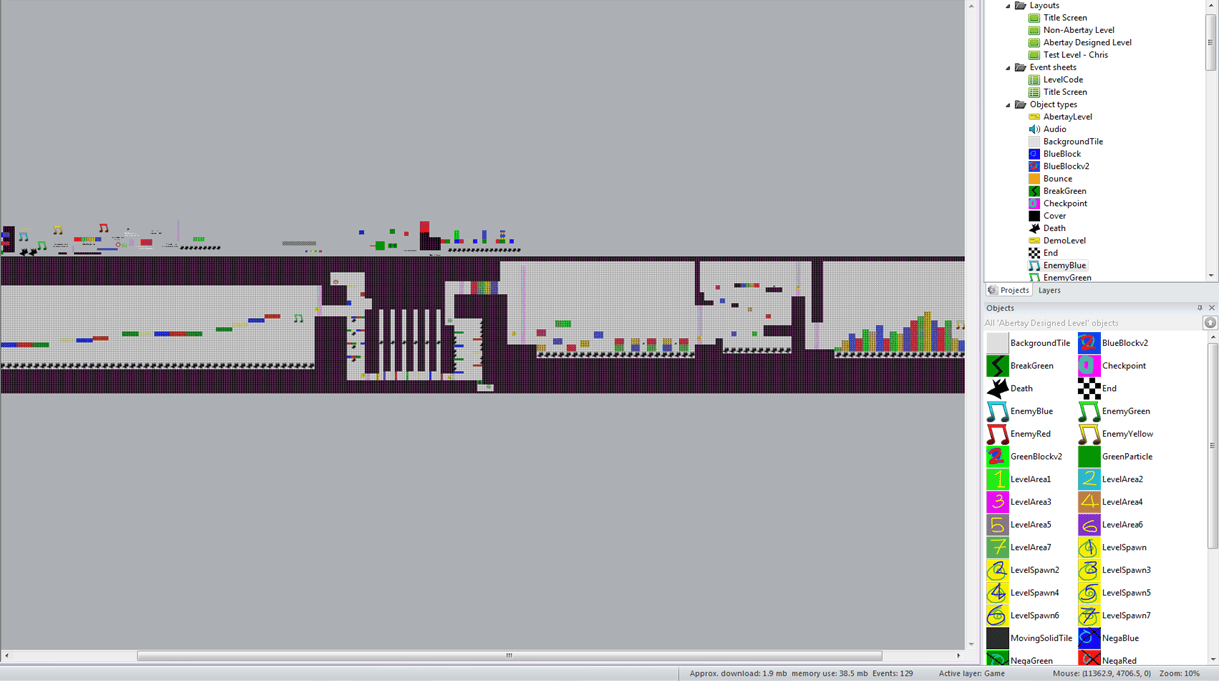
Designed and playtested level ideas around rhythm, movement and timing.
Helped define the core design pillars and used them to protect the young designer’s original intent.
Supported delivery of the project within a focused four week production.
Feature showcase
Rhythm
Movement and obstacles needed to communicate a clear beat so success felt connected to the music rather than ordinary platforming.
Tempo
The level builds pressure by asking players to keep pace through changing colours, obstacles and timing challenges.
Modularity
Reusable pieces allowed the original creator to continue making levels after the project. The system supported variation without losing the game’s central rhythm.
Level design
I playtested the original prototype, identified the strongest ideas and built new features around them. The goal was a challenging but readable flow that stayed faithful to the original concept.